

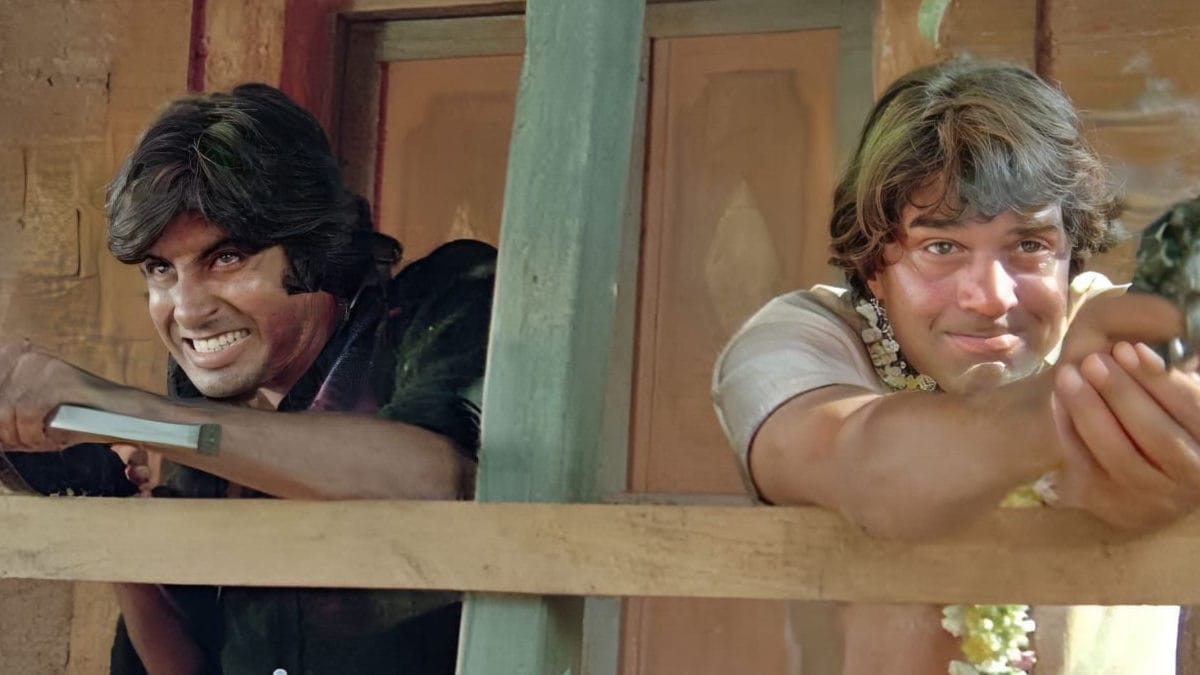
As Sholay completed 50 years this August, its legacy returned to centre stage with a nationwide re-release—this time showcasing the film as it was originally conceived, including the ending in which Gabbar Singh meets his death. Today, Sholay is revered as sacred cinematic history, a benchmark for Indian filmmaking. But few recall that, in its earliest days, the film was regarded as a reckless, even dangerous venture—one that many feared would sink the Hindi film industry.
Long before it became a cultural milestone, Sholay attracted the same suspicion and anxiety that big-budget spectacles face even today. In the years leading up to its release, trade circles buzzed with apprehension over its escalating production costs. The atmosphere was not unlike the debates that now surround mega-budget projects such as Bade Miyan Chote Miyan or Game Changer. Industry insiders argued that such extravagant spending threatened the stability of the entire filmmaking ecosystem. Producers, distributors, and exhibitors worried aloud that films made on such massive scales could never recover their investment and would push studios toward financial ruin.
When Sholay finally hit theatres, these fears seemed, at first, to be entirely justified. Its opening weekend was distinctly underwhelming. Theatres reported thin crowds, ticket sales were disappointing, and early reviews were harsh. Several newspapers declared the film a failure within days, predicting that its makers would never recover the enormous sums they had poured into it.
Director Ramesh Sippy would later describe the industry’s reaction to the film’s faltering start as almost gleeful. Distributors and trade observers felt vindicated, relieved even, that what they considered an irresponsible experiment had stumbled. As Sippy recalled years later, many in the industry openly remarked, “Good that the big film didn’t work,” as though Sholay’s apparent failure had proven their warnings correct.
The silence from the audience in those early days was so unnerving that Sippy considered altering the film’s climax for a second time—this would have resulted in a third version of the ending. But writers Salim Khan and Javed Akhtar refused to waver. They trusted the film and believed it would eventually find its audience. Time, they insisted, would reverse the negative chatter.
Their faith was rewarded. Speaking to Siddharth Kannan years later, Sippy remembered how the tide slowly but dramatically turned. “Five weeks later, they took back everything they wrote,” he said. Publications that had predicted financial disaster now admitted they had misjudged the film. What began as a slow burn erupted into a phenomenon, rewriting box office history and cementing Sholay’s place in Indian culture.
Much of the early hysteria surrounding Sholay stemmed from its unprecedented cost. Initially planned as a ₹1 crore production, the film ultimately ballooned to ₹3 crore—an astronomical figure for the mid-1970s. According to Sippy, ₹1 crore in that era would be roughly equivalent to ₹100 crore today. To many in the trade, the numbers felt not just excessive but irresponsible. There was a widespread belief that if such a costly film collapsed, countless livelihoods across the industry would be jeopardized.
The film’s struggles, however, extended beyond budgets and business anxieties. The censor board intervened heavily, forcing fundamental changes that reshaped the climax. In its original version, Gabbar Singh is killed—a moral resolution that the writers and director felt suited the narrative. But the board objected to the idea of a police officer, played by Sanjeev Kumar, taking a life on screen. It was the period of the Emergency, and as Sippy noted, “You couldn’t argue.” He was ordered to return to Bengaluru to reshoot the ending, replacing Gabbar’s death with his arrest.
Half a century later, Sippy has finally undone the compromise he was forced to make. The restored version of Sholay presented in the 50th anniversary re-release reinstates the original ending—an ending audiences were never meant to miss.
“I felt terrible when they made me change it,” Sippy said. “Why should the censor tell me how to make my film?”
More than a restored scene, this version completes a creative journey interrupted by fear, control, and circumstance. What once felt like a miscalculated risk that nearly broke its makers now stands as a testament to artistic conviction. Sholay’s story reminds us that even legends are born under clouds of doubt—and that time has a way of revealing the truth that early criticism cannot.